About Strado Group
One energy group, four brands
Strado Group is a Belgian B2B energy group that brings the entire energy value chain under one roof, for businesses and energy partners. That runs from energy supply and trading to the smart control of batteries and installations based on market prices. It does so through four brands, Elindus, Entrado, Stelmo and Amplifino, each with its own role, audience and story.
The first two websites on the new platform:
Strado Group is the group website. It tells the story of the full value chain, shares insights, videos and whitepapers for B2B decision-makers, and is where candidates find jobs across the group.
Stelmo is a Belgian energy technology company that steers energy assets automatically, based on market data and forecasting. Its website is aimed at installers, EMS providers, VPP integrators, wholesalers and manufacturers.
A group website and a brand website with different audiences, in several languages, and three more brands in the portfolio. In that situation, you want to avoid every website or language version becoming a separate technical project, with its own costs, maintenance and management.
What was the biggest challenge with your previous websites or your previous way of working?
“We didn’t manage our various websites centrally, so every change took extra time and coordination. The CMS and the translation module weren’t very user-friendly. Sharing content between websites, or translating landing pages and blogs, was particularly cumbersome. On top of that, we kept running into limits: restricted design options, no personalisation, limited tracking and SEO limitations.”
 Stefanie De Groot
Marketing Lead, Strado Group
What we built
A future-proof multibrand platform
Blastic built the new websites for Strado Group and Stelmo on Prepr as a headless CMS, with a Next.js front end. The platform is multibrand and multilingual: the websites share one technical foundation, with room for each brand's own character. Future brands and languages can be added without starting a new project from scratch each time.
What that includes:
A shared architecture that runs multiple brand websites.
Multilingual support built in from the start, so each brand speaks to its audience in the right language.
Content models in Prepr for insights, videos, whitepapers and jobs, among others.
A Next.js front end with its own look for each brand.
Forms via Odoo Forms, including contact forms with CV upload.
Connections to each brand's social media channels.
A complete web standard covering SEO, security, accessibility, performance and GDPR compliance.


Our solution
How did Blastic bring design and development closer together?
On this project, Blastic worked with Claude Code, Figma MCP and Atlassian MCP. With this set-up, AI reads the designs directly from Figma. Based on those designs, tickets in Jira and documentation in Confluence are created automatically. These form the starting point for building the components in code afterwards.
As a result, what gets designed matches what gets built more closely, with less manual translation between design, planning and development. Importantly, AI doesn't replace expertise. Our developers define the architecture, review the output and safeguard the quality.
The platform uses shared building blocks for what the brands have in common, and leaves room for what sets them apart:
Flexible content models: editors build pages from reusable blocks in Prepr, without needing developers.
Multilingual management: all language versions are managed centrally, within the same structure.
Their own brand identity: Strado Group and Stelmo each have their own look, audience and tone of voice.
Ready for the next brands: if Strado Group wants to bring Elindus, Entrado or Amplifino onto the platform, the existing architecture and content models are the starting point.
Built to be findable, secure and accessible
A website has to fit the brand. It also has to be findable, secure and usable for everyone. That's why these aspects were built in from the start, not added afterwards:
SEO: a technical foundation with the right metadata and structure for each brand and each language, so every brand builds its own search visibility in every market.
Security: thanks to the headless set-up, the CMS is separated from the public website.
an enforced Content Security Policy with monitoring
security headers
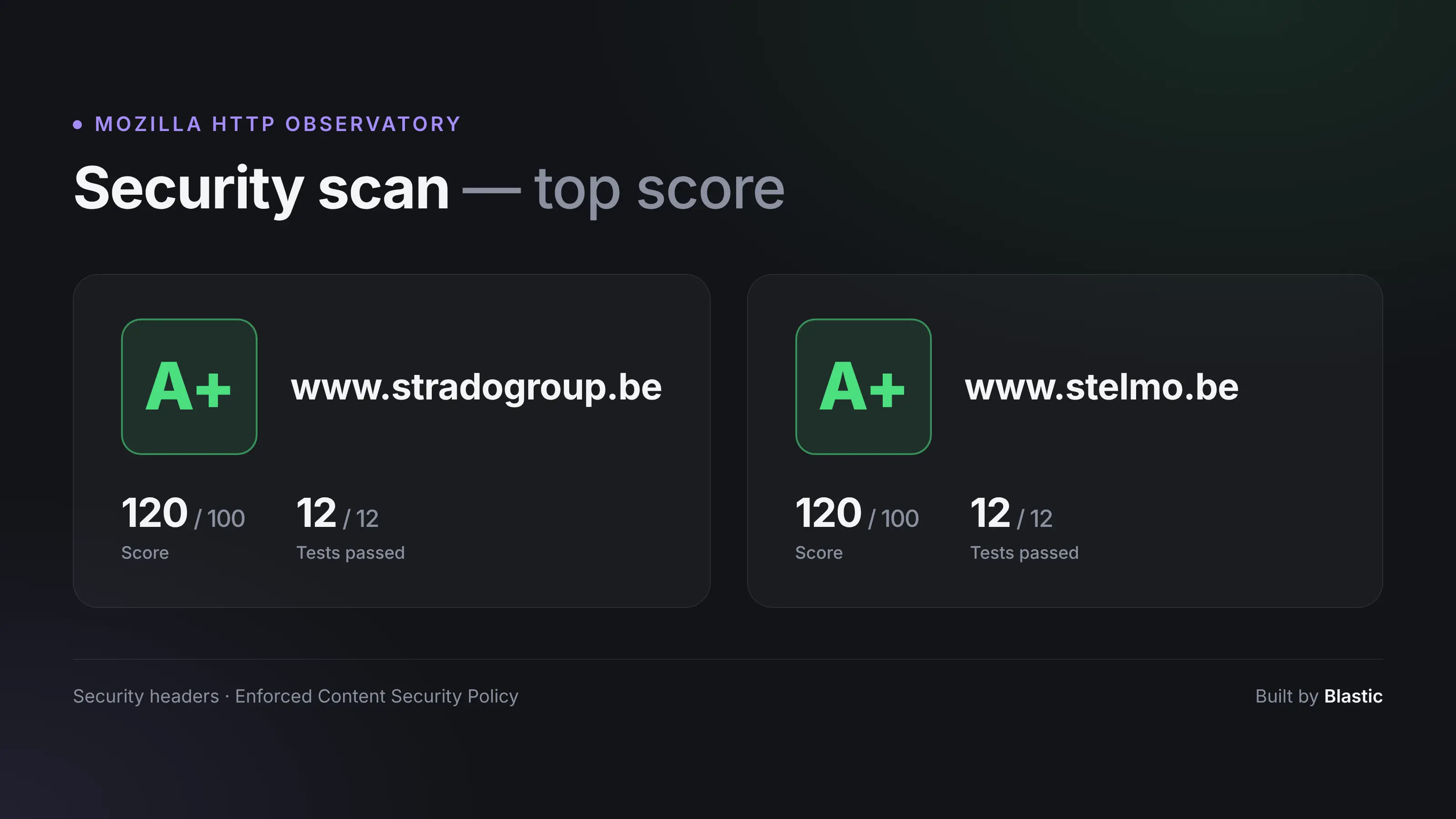
an A+ rating on ImmuniWeb, Mozilla Observatory and SSL Labs
Accessibility: built with web accessibility in mind, so as many people as possible can use the websites.
Performance: fast loading times, thanks to Next.js, Prepr CDN and lazy loading.
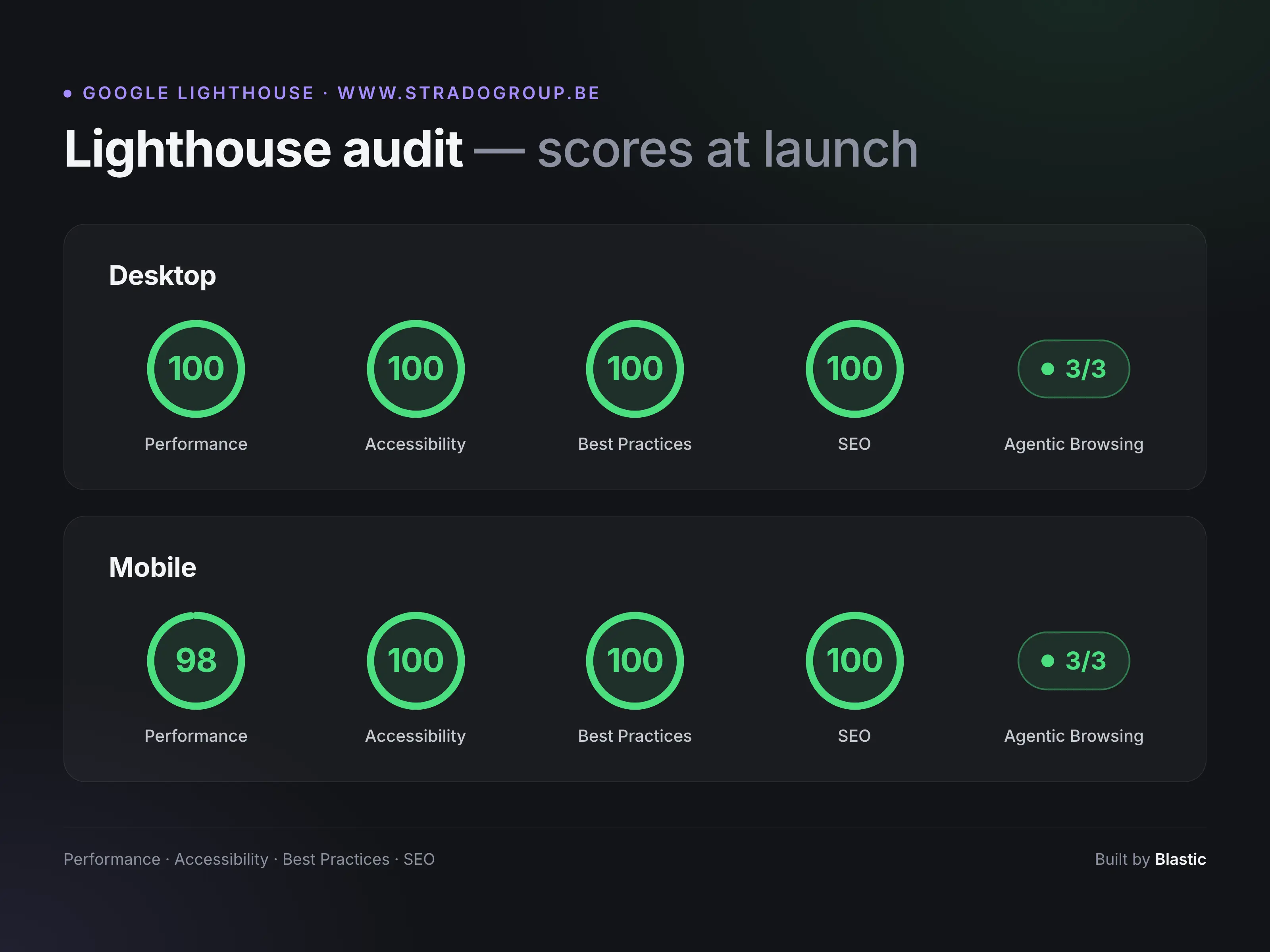
Lighthouse audit scores of 98 to 100 at launch
GDPR: the websites fully comply with GDPR rules, including the forms candidates use to submit their CVs.
Online presence: the websites are connected to each brand's channels. Strado Group is active on LinkedIn, Instagram and YouTube. Stelmo is active on LinkedIn and YouTube.
What are the first results?
In the first week after launch, 25 job applications with a CV attached came in. That's an early, concrete sign that the new websites are doing their job: candidates are finding their way and taking the step to get in touch.
It's still a first data point, not a final verdict. To understand what the number really means, we'll compare it with the period before launch and track how it develops.
A launch proves that a platform works. Whether it makes a difference only becomes clear later. That's why Blastic continues to monitor technical quality: SEO (Google Search Console), security (Blastic CSP reporting) and accessibility (Blastic A11y Dashboard).
Frequently asked questions
How long does it take to build a multibrand platform?
For Strado Group it took about five months from analysis to launch, for two websites, of which about 2 months was development and QA. Two things determine the lead time most:
The step from approved design to working functionality.
In a design-led project, development waits for the designs, and only once something is built in Prepr and on the website do you see whether it works the way it was intended.How well the components are guarded across all brands.
If every brand introduces its own components, it takes considerably longer. For Strado Group, BBC Design kept the components consistently shared across the brands. Being creative with a shared component stack is the key here.
Extra languages mainly mean extra content, not extra development.
What do the brands share, and what stays separate?
The codebase, components, content structure and Prepr integration are shared. Each brand keeps its own Prepr environment, domain, hosting and visual identity, set through design tokens per brand. A new brand gets everything that is already built, without brands affecting each other's content or releases.
Can the same content be used on channels other than the website later?
Yes. In Prepr the content is separate from the website, and every channel fetches it through the same API. The Strado Group and Stelmo websites are the first channels. An app, a customer portal or screens can use the same content later, without a new CMS and without entering the content again.
Is the solution locked in to Prepr?
No. The code is deliberately built without vendor lock-in: Prepr only delivers content through an API and can be swapped out. Switching CMS later means reconnecting the content layer and migrating the content, not rebuilding the websites.
Do you have to use Next.js with a headless CMS?
No, a headless CMS works with any framework. For Strado Group we chose Next.js: it builds on React, and the server features that made it popular, such as middleware, were mature when the project started. We were confident it could handle our hard requirements.
Can I easily migrate from a traditional CMS or DXP to a headless CMS?
For Strado Group we built new websites, but the same approach works if you're coming from a traditional CMS or DXP. Technically the switch is very doable; moving the content is often the most intensive part.
In a traditional CMS or DXP, content is usually tangled up with pages, templates and layout, while a headless CMS expects structured content. That is why a migration starts with a thorough analysis: which content moves along, what the new content model looks like, and how the existing content is converted into it. AI can speed up much of that conversion work. That is what we specialise in.
Quick overview
Client: Strado Group
Websites:
Technology: Prepr (headless CMS), Next.js, Odoo Forms
Methodology:
Figma to code (Figma MCP)
Code to content (Prepr MCP)
Content to automated testing, auditing and monitoring
Partners:
Elindus: infrastructure, testing, project direction
BBC Design: content, Figma design, project direction
Unform: Figma MCP ready design
Somko: Odoo integration and support
Kastori: technology selection
Contact
One brand or several, one language or many: in a first conversation we look at whether a headless platform supports your goals, and what an analysis should cover.
A new project for every brand?
Discover what a multibrand platform could mean for your organisation.
Book a no-obligation call. Together, we'll look at your current websites and show you where one platform saves time, money and headaches.