
Are you still waiting for the delivery guy to add memory to your web server? Are there other options, or should we all jump on the trend of serverless hosting?
Since the start of the World Wide Web, a web page has been delivered by a server somewhere that sends the requested page back to your browser. A lot has changed since that first page in 1991, but a page is still returned to your browser by a server in one way or another.
Today, depending on the traffic, one or more servers share the load so every page is delivered quickly. Depending on the architecture, the page is ready on the server and simply returned (static site generation), or, more commonly, the page is built for each request (server-side rendering).
Each step takes work off your hands
The evolution
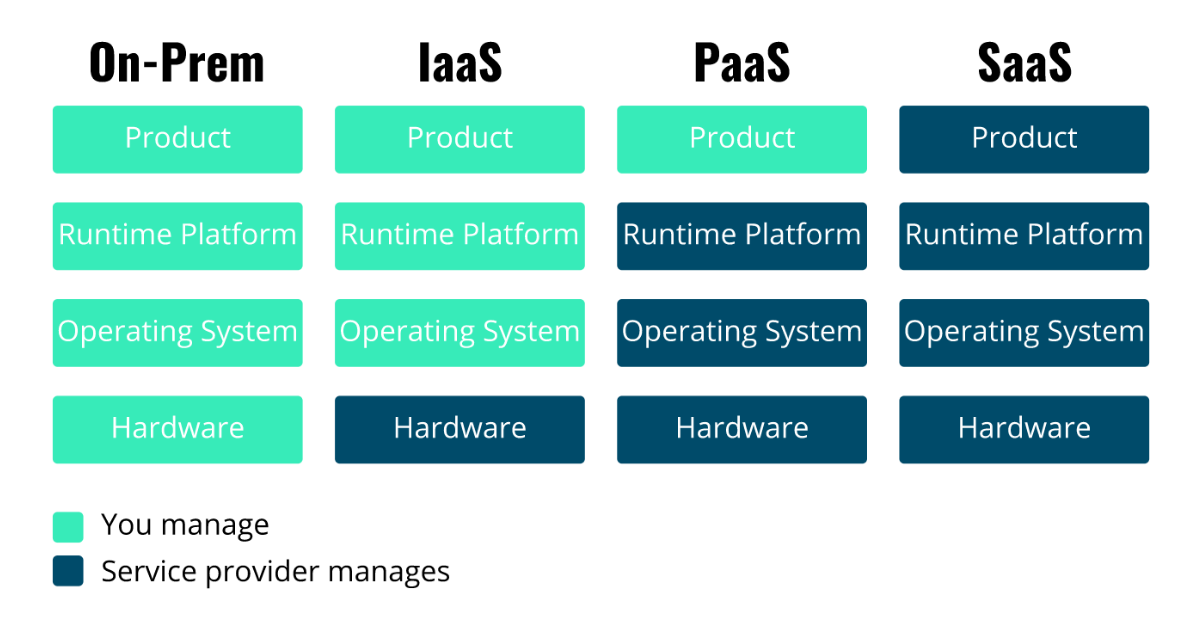
From on-premises servers to software as a service: at each step, the provider takes over more layers, and you manage fewer.
Infrastructure as a service
IaaS
The on-premises server in your own building has evolved into some form of cloud computing. The closest to it is infrastructure as a service (IaaS). You still have a virtual machine (the server) you can log in to, and from a software point of view nothing changes. But all hardware maintenance moves to the cloud provider.
In fact, you move your on-premises data centre to the cloud. You can still log in to your server and set it up as you like, without worrying about hardware. But you still do all configuration and software patching yourself.
Platform as a service
PaaS
One level up, you host your application on a platform. You have no direct access to the machine and can't log in. But you still decide what runs on the platform: your code or product and its configuration. You get a place for your application and all the flexibility you need, within the runtime of the platform.
When the configuration is just the web application package itself, releases become very simple. Scaling gets easier too, by adding "servers" or adding resources to them. The biggest advantage: hardware, platform security and platform maintenance are handled by the cloud provider.
Where does serverless fit in?
Serverless
Serverless is mostly linked to functions as a service: small pieces of code that handle a specific task and only run when called. They can render a page on the server, handle form submissions and much more.
Need code that transforms data between bigger systems, or resizes images for a specific use? Functions do that, and much more. Web frameworks like Next.js even use functions to combine static site generation with server-side rendering. And yes: under the hood, serverless still runs on servers. You just don't manage them.
Software as a service
SaaS
The next level up is the software that runs on those platforms. The server that once simply served your website has become much more: it lets you manage content and give every visitor a unique experience. The content management system (CMS) has become a key part of your web experience.
Abstracting all of that away brings a risk: the platform can become too rigid. Vendors solve that in different ways, from offering the CMS as a content-as-a-service platform to adding integration points for more flexibility.
With SaaS, the vendor handles all maintenance: hardware, operating system patches and software updates. You focus on your key requirements and the functionality you need.
Evaluate before you choose
Choosing
The evolution never stops: there will always be new ways to abstract the lower layers. That's why it's more important than ever to evaluate your needs and requirements before you choose a platform. Today, that includes where your data lives and who controls it.
Want to know more about hosting options, or do you have questions? Get in touch with our experts: they're happy to help.
Get in touch
Ready to take your digital experience to the next level? Feel free to contact us to learn more about our services and how we can help you leverage the full potential of your digital marketing.
More on technology
Tell us about your project
And we'll come up with a tailor-made solution
Get in touch with one of our consultants to find the perfect match that fits your needs and enables you to grow.